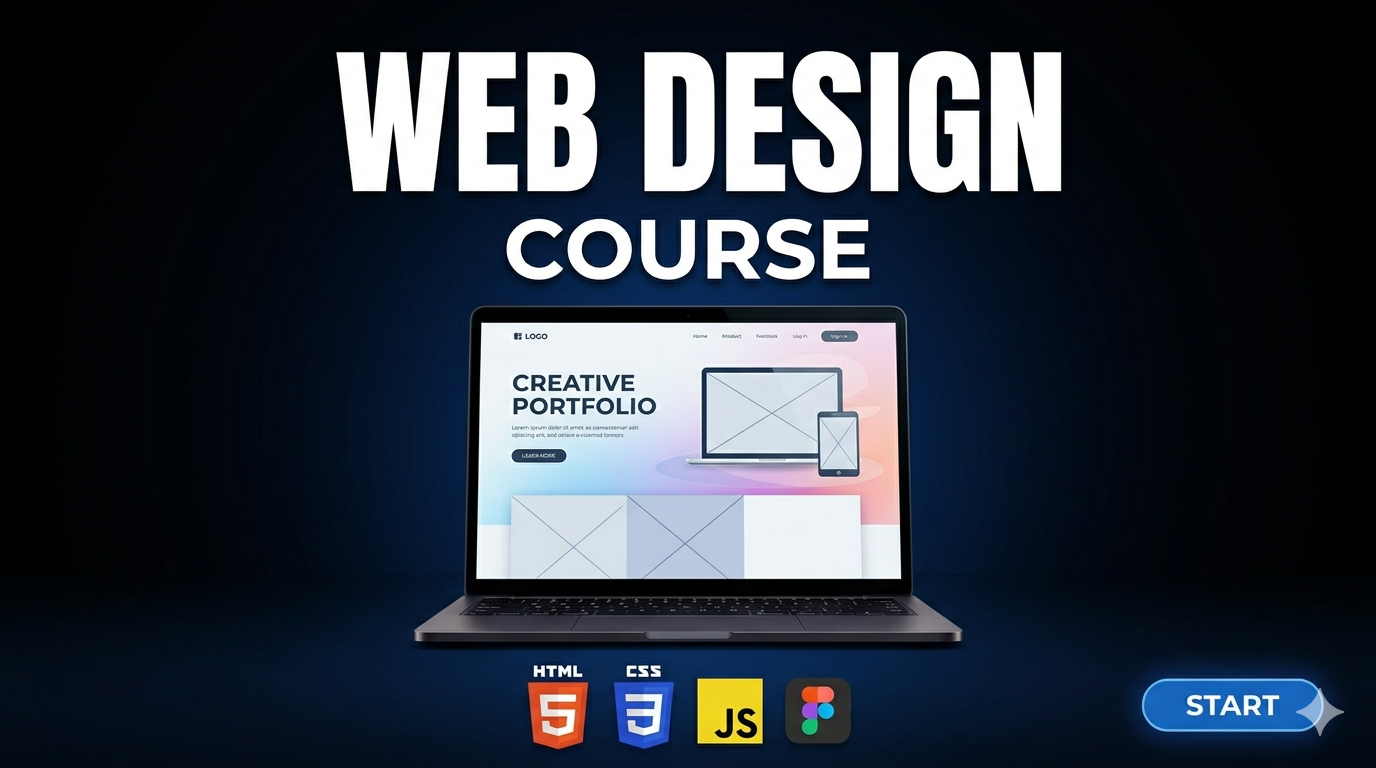
This Web Design course introduces students to the fundamentals of building modern websites using HTML, CSS, and JavaScript. Over 10 sessions, learners will progress from structuring web pages to styling and adding interactivity. The course concludes with a hands-on final project where students create their own complete website, integrating all learned skills in a practical and creative way.
By the end of this course, students will be able to:
Lesson 1: Introduction to Web Development & How the Web Works In this first session, students are introduced to the world of web development and how websites function behind the scenes. They will learn the basic structure of the internet, including how browsers, servers, and domains interact to display web pages. The lesson also covers the difference between front-end and back-end development, helping students understand the full picture of website creation. By the end of the session, students will be familiar with essential web development tools, set up their working environment, and write their first simple HTML code, marking their first step into building real websites.
In this lesson, students explore the core building blocks of HTML: tags and elements. They will learn how tags define structure and meaning in a webpage, and how opening and closing tags work together to create complete elements. Students will practice using common HTML elements such as headings, paragraphs, links, images, and lists. The session focuses on understanding how to properly organize content and how each element contributes to the structure of a web page. By the end of the lesson, students will be able to confidently write and combine HTML tags to build well-structured and readable web pages.
In this lesson, students explore core concepts of web development. They will learn how to structure content meaningfully using semantic HTML, organize data and collect user input through tables and forms, and enhance their web pages by seamlessly embedding HTML5 media. The session also introduces site expansion techniques to help learners scale individual pages into complete, interconnected websites. By the end of the lesson, students will be able to confidently combine these essential front-end building blocks to construct well-organized, interactive, and media-rich web projects.
In this lesson, students are introduced to the aesthetic side of web development through CSS, moving beyond structure to focus on the visual presentation of a website. They will learn the fundamentals of text and color styling to create engaging user interfaces, as well as the essential concepts of the CSS Box Model, which governs how elements are sized and spaced on a page. The session emphasizes the practical application of styles, teaching students how to effectively target HTML elements to transform plain code into a polished, professional design. By the end of the lesson, students will be able to confidently apply CSS rules to control the layout and appearance of their web projects.
No Review found
Discover Additional Learning Opportunities
 Beginner
 Beginner
 Beginner
 Beginner
 Beginner